VEGFA Rabbit Monoclonal antibody
VEGF, 7H10, L-VEGF, N-VEGF, Vascular Endothelial Growth Factor
-
货号:
RM20185 -
规格:
- 20ul
- 50ul
- 100ul
- 150ul
-
价格:
¥0.00
VEGF, 7H10, L-VEGF, N-VEGF, Vascular Endothelial Growth Factor
| 产品类型 | Monoclonal |
| 基因名称 | vascular endothelial growth factor A |
| 经测试应用 | WB, IF/ICC |
| 宿主 | Rabbit |
| 种属反应性 | Human, Mouse |
| 免疫原 | A synthesized peptide derived from human VEGFA |
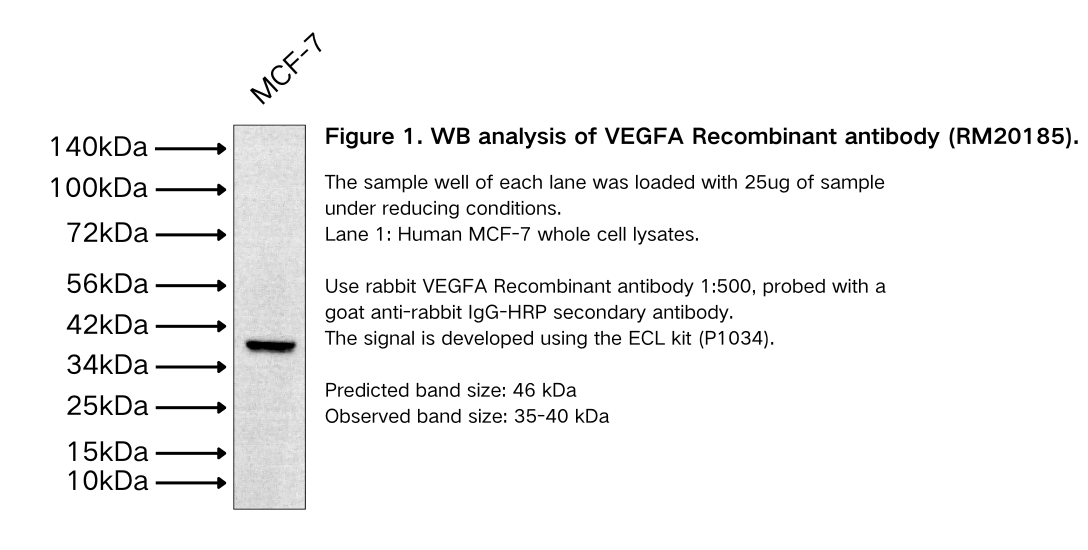
| 理论分子量 | 46 kDa |
| 实际分子量 | 35-40 kDa |
| Gene ID(NCBI) | 7422 |
| GeneBank Accession Number | BC065522 |
| UNIPROT | P15692 |
| 形式 | Liquid |
| 保存条件 | Store at -20℃. Stable for one year after shipment. Aliquoting is unnecessary for -20℃ storage. |
| 推荐稀释比例 | 1:500-1:2500 |
| 背景信息 | This gene is a member of the PDGF/VEGF growth factor family. It encodes a heparin-binding protein, which exists as a disulfide-linked homodimer. This growth factor induces proliferation and migration of vascular endothelial cells, and is essential for both physiological and pathological angiogenesis. Disruption of this gene in mice resulted in abnormal embryonic blood vessel formation. This gene is upregulated in many known tumors and its expression is correlated with tumor stage and progression. Elevated levels of this protein are found in patients with POEMS syndrome, also known as Crow-Fukase syndrome. Allelic variants of this gene have been associated with microvascular complications of diabetes 1 (MVCD1) and atherosclerosis. Alternatively spliced transcript variants encoding different isoforms have been described. There is also evidence for alternative translation initiation from upstream non-AUG (CUG) codons resulting in additional isoforms. A recent study showed that a C-terminally extended isoform is produced by use of an alternative in-frame translation termination codon via a stop codon readthrough mechanism, and that this isoform is antiangiogenic. Expression of some isoforms derived from the AUG start codon is regulated by a small upstream open reading frame, which is located within an internal ribosome entry site. The levels of VEGF are increased during infection with severe acute respiratory syndrome coronavirus 2 (SARS-CoV-2), thus promoting inflammation by facilitating recruitment of inflammatory cells, and by increasing the level of angiopoietin II (Ang II), one of two products of the SARS-CoV-2 binding target, angiotensin-converting enzyme 2 (ACE2). In turn, Ang II facilitates the elevation of VEGF, thus forming a vicious cycle in the release of inflammatory cytokines. |

邮箱:info@TianyaBio.com
电话:020-3107 8154
地址:广州市番禺区兴业大道东路1078号2-50

微信公众号

微信客服