HA Peptide
HA Peptide (HA tag) 是来自人类流感血凝素 (HA) 的由九个氨基酸组成的多肽。HA Peptide 广泛用于细胞生物学和生物化学中分离,纯化,检测和追踪目标蛋白。
-
货号:
TK0605 -
规格:
- 1mg
- 5mg
- 10mg
-
价格:
¥0.00
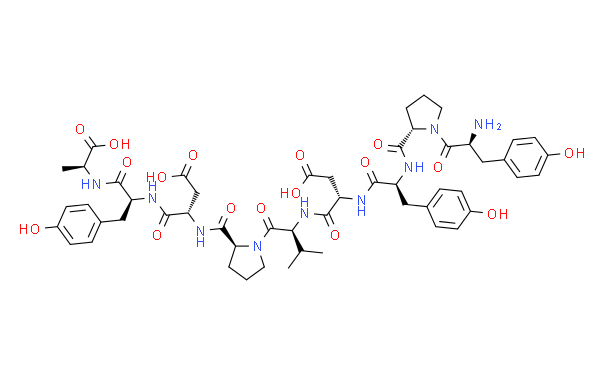
HA Peptide (HA tag) 是来自人类流感血凝素 (HA) 的由九个氨基酸组成的多肽。HA Peptide 广泛用于细胞生物学和生物化学中分离,纯化,检测和追踪目标蛋白。
| CAS No. | 92000-76-5 |
| 生物活性 | HA Peptide (HA tag) is a nine amino acids peptide derived from the human influenza hemagglutinin (HA). HA Peptide is extensively used to isolate, purify, detect, and track the protein of interest in cell biology and biochemistry. |
| 分子式 | C53H67N9O17 |
| 分子量 | 1102.15 |
| 运输条件 | Room temperature in continental US; may vary elsewhere. |
| 储存条件 | Powder -80°C 2 years |
| 溶解性数据 | H2O : 50 mg/mL (45.37 mM; Need ultrasonic) |
| 体外研究 | HA Peptide is a highly immunoreactive tag generally used for the separation of tagged proteins from cell culture supernatants and cell lysate under neutral pH conditions and thus are handy tools for coimmunoprecipitation but are also easily detected via western blot. HA Peptide is small and thus unlikely to interfere with the bioactivity and function of the fusion partner proteins. HA Peptide comes from human influenza hemagglutinin (HA) corresponding to amino acids 98–106 and is a strong immunoreactive epitope making it popular to isolate, purify, detect, and track the protein of interest. The recombinant HA-tagged proteins can be separated by highly specific anti-HA monoclonal antibody that is covalently immobilized on resin. The HA-tagged proteins can be eluted by mild elution approach with HA epitope at 1 mg/mL in TBS. On the other hand, three chemical elution options are available: 0.1 M glycine (pH 2-2.8), 3 M NaSCN, or 50 mM NaOH. The nucleotide sequences encoding an N-terminal HA Peptide in the mammalian expression vectors is an essential element for the T7 promoter-driven expression in E. coli even without trans-acting T7 RNAP. Research results suggest that HA Peptide is cleaved by caspase 3/7, and HA Peptide cleavage results in a total loss of immunoreactivity. Observations indicate that the use of HA to tag proteins and constructs to study cell death–related and apoptotic mechanisms can result in serious artifacts. |
| 文献 | •Mol Cell. 2020 Feb 20;77(4):734-747.e7. •Theranostics. 2020 Apr 27;10(13):5845-5864. •Oncogene. 2019 Jan;38(5):747-764. |
| 纯度及产品资料 | 98% |

邮箱:info@TianyaBio.com
电话:020-3107 8154
地址:广州市番禺区兴业大道东路1078号2-50

微信公众号

微信客服