Reparixin L-lysine salt Repertaxin L-lysine salt
Reparixin L-lysine salt是趋化因子受体1/2 (CXCR1/2)活化 的变构抑制剂。
-
货号:
TK0593 -
规格:
- 1mg
- 5mg
- 10mg
-
价格:
¥0.00
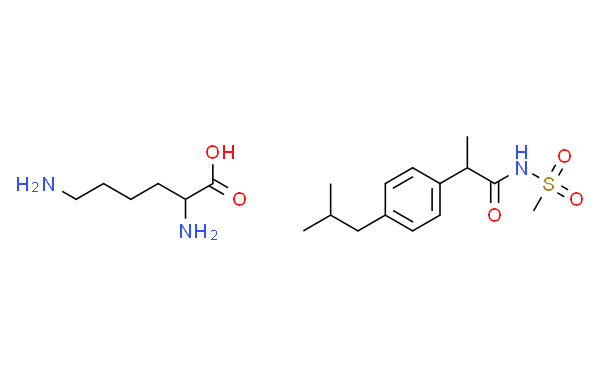
Reparixin L-lysine salt是趋化因子受体1/2 (CXCR1/2)活化 的变构抑制剂。
| CAS No. | 266359-93-7 |
| 生物活性 | Reparixin L-lysine salt is an allosteric inhibitor of chemokine receptor 1/2 (CXCR1/2) activation. |
| 分子式 | C20H35N3O5S |
| 分子量 | 429.57 |
| 运输条件 | Room temperature in continental US; may vary elsewhere. |
| 储存条件 | Powder -20°C 3 years |
| 溶解性数据 | H2O : 100 mg/mL (232.79 mM; Need ultrasonic) DMSO : 100 mg/mL (232.79 mM; Need ultrasonic) |
| 体内研究 | The pharmacokinetics and metabolism of Reparixin are investigated in rats and dogs after intravenous administration of [C]-Reparixin L-lysine salt. Plasma protein binding of Reparixin is >99% in the laboratory animals and humans up to 50 µg/mL, but lower at higher concentrations. Although radioactivity is rapidly distributed into rat tissues, Vss is low (about 0.15 L/kg) in both rat and dog. Nevertheless, Reparixin is more rapidly eliminated in rats (t1/2~0.5 h) than in dogs (t1/2~10 h). |
| 体外研究 | Reparixin is a potent functional inhibitor of CXCL8-induced biological activities on human PMNs with a marked selectivity (around 400-fold) for CXCR1, as shown in specific experiments on CXCR1/L1.2 and CXCR2/L1.2 transfected cells and on human PMNs. The efficacy of Reparixin is significantly lower in L1.2 cells expressing Ile43Val CXCR1 mutant (IC50 values of 5.6 nM and 80 nM for CXCR1 wt and CXCR1 Ile43Val, respectively). Reparixin is a non-competitive allosteric inhibitor of IL-8 receptors with a 400-fold higher efficacy in inhibiting CXCR1 activity than CXCR2. |
| 文献 | •Ann Rheum Dis. 2016 Apr;75(4):730-8. •Ann Rheum Dis. 2016 Apr;75(4):721-9. •Nat Commun. 2017 May 26;8:15584. •Sci Adv. 2019 May 8;5(5):eaav7384. •J Allergy Clin Immunol. 2018 Jun;141(6):2286-2289.e5. •Cell Death Dis. 2017 Jul 13;8(7):e2932. •EBioMedicine. 2019 May;43:487-500. •Front Immunol. 2021 May 7;12:667177. •Front Immunol. 2018 Sep 12;9:2058. •Oncogenesis. 2016 Jun 13;5(6):e234. •Cell Biosci. 2019 Jan 3;9:4. •Stem Cells. 2015 Dec;33(12):3558-68. •Neurobiol Dis. 29 October 2021, 105538. •Cancer Cell Int. 2021 Jul 3;21(1):337. •J Immunol. 2018 Jul 15;201(2):814-820. •J Cell Mol Med. 2020 Nov;24(21):12608-12618. •J Cell Mol Med. 2020 Jan;24(2):1588-1598. •J Mol Med (Berl). 2019 Jan;97(1):25-35. •Mol Immunol. 2018 Aug 7;101:440-449. •Sci Rep. 2017 Nov 6;7(1):14510. •Biochim Biophys Acta. 2017 Jan;1863(1):220-230. •Gene. 2018 Nov 30;677:149-162. •Xenotransplantation. 2018 Mar;25(2):e12385. •J Gastroenterol Hepatol. 2018 Feb;33(2):431-442. •Biomed Res Int. 2020 Aug 5;2020:4670604. •Vet Immunol Immunopathol. 2016 Dec;182:52-58. •Research Square Preprint. 2022 Jan. •Research Square Preprint. 2021 Mar. •bioRxiv. 2020 Sep 12;2020.08.25.265561. •FACETS. 2020 Jul. •University of Michigan. 2018 Oct. •Oncotarget. 2018 Aug 24;9(66):32556-32569. •Oncotarget. 2017 Jul 21;8(36):60210-60222. •Patent. US20170181987A1. •Patent. US20170105971A1. •Johns Hopkins University. Department of Chemical and Biomolecular Engineering. 2016 Dec. |
| 纯度及产品资料 | 98% |

邮箱:info@TianyaBio.com
电话:020-3107 8154
地址:广州市番禺区兴业大道东路1078号2-50

微信公众号

微信客服