咨询热线:

020-3107 8154

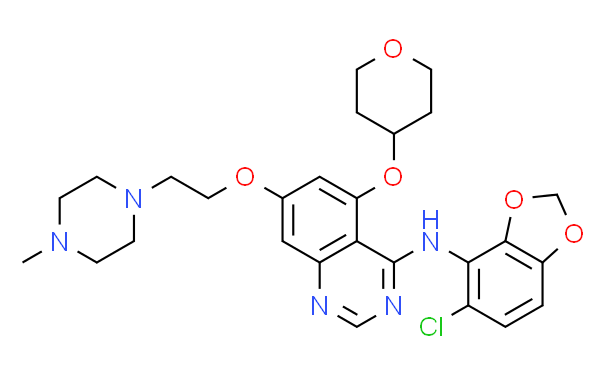
Saracatinib (AZD0530) 司马沙尼; SU5416

Saracatinib (AZD0530)是一种有效的Src抑制剂,无细胞试验中IC50为2.7 nM,对c-Yes, Fyn, Lyn, Blk, Fgr和Lck也具有活性;但对Abl和EGFR (L858R和L861Q)活性较低。Saracatinib可诱导自噬。Phase 2/3。

  • 货号:
    TK0431
  • 规格:
    1mg
    10mg
    50mg
  • 价格:
    0.00

产品参数

CAS No.379231-04-6
生物活性Saracatinib (AZD0530) is a potent Src family inhibitor with IC50s of 2.7 to 11 nM for c-Src, Lck, c-YES, Lyn, Fyn, Fgr, and Blk. Saracatinib shows high selectivity over other tyrosine kinases.
分子式 C27H32ClN5O5
分子量542.03
储存条件Powder -20°C 3 years 4°C 2 years In solvent -80°C 6 months -20°C 1 month
溶解性数据DMSO : 100 mg/mL (184.49 mM; Need ultrasonic)
体内研究Saracatinib (AZD0530) treatment potently inhibits the proliferation of subcutaneously transplanted Src3T3 fibroblasts in mice and rats in a dose-dependent manner. In both models, significant inhibition of tumor growth is seen at doses ≥6 mg/kg/day (60% inhibition in mice and 98% inhibition in rats versus animals treated with vehicle) and, at the maximum doses investigated, complete tumor growth inhibition is observed (100% inhibition at 25 mg/kg/day in mice and 10 mg/kg/day in rats).
体外研究Saracatinib (AZD0530), an orally available Src inhibitor, demonstrates potent antimigratory and anti-invasive effects in vitro, and inhibits metastasis in a murine model of bladder cancer. Antiproliferative activity of Saracatinib varies between cell lines (IC50 of 0.2-10 μM). Saracatinib potently inhibits the proliferation of Src3T3 mouse fibroblasts and demonstrates variable antiproliferative activity in a range of human cancer cell lines containing endogenous Src. Sub micromolar growth inhibition of five of the human cancer cell lines tested with Saracatinib (tumor types: colon, prostate, lung, and leukemia) is observed with IC50 values of 0.2-0.7 μM. In 3-day MTS cell proliferation assays, Saracatinib inhibits proliferation of the Bcr-Abl-driven human leukemia cell line K562 with an IC50 of 0.22 μM. In the microdroplet migration assay, Saracatinib reduces the migration of human lung cancer A549 cells in a concentration-dependent manner (IC50 0.14 μM).