Torkinib PP 242
Torkinib (PP242) 是一种选择性的mTOR抑制剂,在无细胞试验中IC50为8 nM;靶向作用于mTOR复合体,作用于mTOR比作用于PI3Kδ或PI3Kα/β/γ选择性分别高10倍多和100倍。Torkinib (PP242) 可诱导线粒体自噬和凋亡。
-
货号:
TK0408 -
规格:
- 1mg
- 5mg
- 10mg
- 50mg
-
价格:
¥0.00
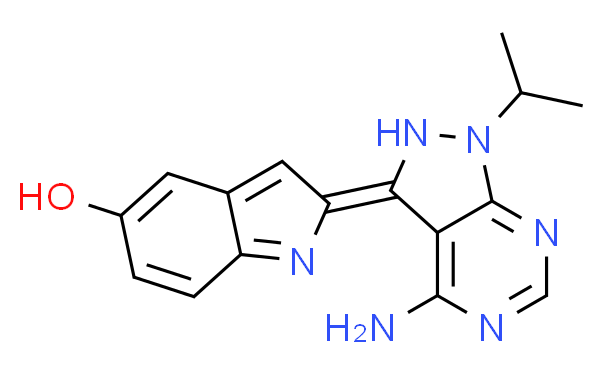
Torkinib (PP242) 是一种选择性的mTOR抑制剂,在无细胞试验中IC50为8 nM;靶向作用于mTOR复合体,作用于mTOR比作用于PI3Kδ或PI3Kα/β/γ选择性分别高10倍多和100倍。Torkinib (PP242) 可诱导线粒体自噬和凋亡。
| CAS No. | 1092351-67-1 |
| 生物活性 | Torkinib (PP 242) is a selective and ATP-competitive mTOR inhibitor with an IC50 of 8 nM. PP242 inhibits both mTORC1 and mTORC2 with IC50s of 30 nM and 58 nM, respectively. |
| 分子式 | C16H16N6O |
| 分子量 | 308.34 |
| 储存条件 | Powder -20℃ 3 years |
| 溶解性数据 | DMSO : 50 mg/mL (162.16 mM; Need ultrasonic) |
| 体内研究 | In fat and liver, Torkinib (PP 242) is able to completely inhibit the phosphorylation of Akt at S473 and T308, consistent with its effect on these phosphorylation sites observed in cell culture. Surprisingly, Torkinib (PP 242) is only partially able to inhibit the phosphorylation of Akt in skeletal muscle and is more effective at inhibiting the phosphorylation of T308 than S473, despite it's ability to fully inhibit the phosphorylation of 4EBP1 and S6. These results will be confirmed by in vivo dose-response experiments, but, consistent with the partial effect of Torkinib (PP 242) on pAkt in skeletal muscle, a muscle-specific knockout of the integral mTORC2 component rictor resulted in only a partial loss of Akt phosphorylation at S473. These results suggest that a kinase other than mTOR, such as DNA-PK, may contribute to phosphorylation of Akt in muscle. |
| 体外研究 | Torkinib (PP 242) potently inhibits mTOR (IC50=8 nM) but is much less active against other PI3K family members. Testing of Torkinib (PP 242) against 219 protein kinases reveals remarkable selectivity relative to the protein kinome: at a concentration 100-fold above its IC50 for mTOR, Torkinib (PP 242) inhibits only one kinase by more than 90% (Ret) and only three by more than 75% (PKCα, PKCβII and JAK2). Torkinib (PP 242) has a dose-dependent effect on proliferation and at higher doses is much more effective than Rapamycin at blocking cell proliferation. The ability of Torkinib (PP 242) to block cell proliferation more efficiently than Rapamycin could be a result of its ability to inhibit mTORC1 and mTORC2, because Rapamycin can only inhibit mTORC1. In SIN1 mouse embryonic fibroblasts (MEFs), Rapamycin is also less effective at blocking cell proliferation than Torkinib. That Torkinib (PP 242) and Rapamycin exhibit very different anti-proliferative effects in SIN1 MEFs suggests that the two compounds differentially affect mTORC1. |
| 文献 | 暂无相关参考文献 |
| 纯度及产品资料 | 98% |

邮箱:info@TianyaBio.com
电话:020-3107 8154
地址:广州市番禺区兴业大道东路1078号2-50

微信公众号

微信客服