Ganetespib STA-9090
Ganetespib (STA-9090) 是一种热休克蛋白 90 (HSP90) 抑制剂,在多种血液和实体肿瘤细胞系中表现出有效的细胞毒性。Ganetespib 通过抑制 HIF-1α 和 STAT3 对大肠癌具有抗血管生成作用。
-
货号:
TK0282 -
规格:
- 1mg
- 5mg
- 10mg
-
价格:
¥0.00
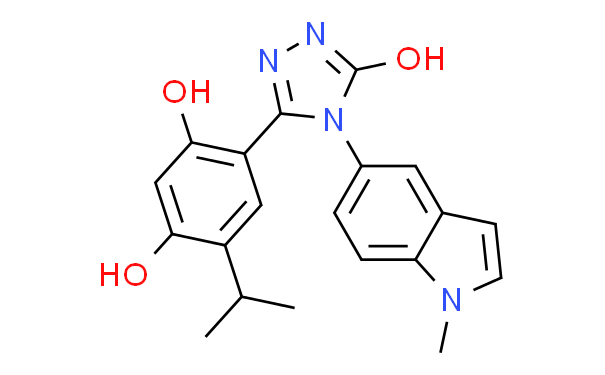
Ganetespib (STA-9090) 是一种热休克蛋白 90 (HSP90) 抑制剂,在多种血液和实体肿瘤细胞系中表现出有效的细胞毒性。Ganetespib 通过抑制 HIF-1α 和 STAT3 对大肠癌具有抗血管生成作用。
| CAS No. | 888216-25-9 |
| 生物活性 | Ganetespib (STA-9090) is a heat shock protein 90 (HSP90) inhibitor which exhibits potent cytotoxicity in a wide variety of hematological and solid tumor cell lines. Ganetespib has antiangiogenic effects in colorectal cancer mediated through inhibition of HIF-1α and STAT3. |
| 分子式 | C20H20N4O3 |
| 分子量 | 364.40 |
| 运输条件 | Room temperature in continental US; may vary elsewhere. |
| 储存条件 | Powder -20°C 3 years |
| 溶解性数据 | DMSO : ≥ 32 mg/mL (87.82 mM) |
| 体内研究 | Ganetespib (125 mg/kg, i.v.) accumulates in tumors relative to normal tissues and displays greater in vivo efficacy than 17-AAG without increased toxicity and inhibits proliferation and induces apoptosis in parallel with EGFR depletion in NCI-H1975 xenografts. Ganetespib (100, 125, 150 mg/kg, i.v.) shows potent antitumor efficacy in solid and hematologic xenograft models of oncogene addiction, as evidenced by significant growth inhibition and/or regressions. |
| 体外研究 | Ganetespib causes depletion of receptor tyrosine kinases, extinguishing of downstream signaling, inhibition of proliferation and induction of apoptosis with IC50 values ranging 2-30 nM in genomically-defined NSCLC cell lines. Ganetespib is also approximately 20-fold more potent in isogenic Ba/F3 pro-B cells rendered IL-3 independent by expression of EGFR and ERBB2 mutants. Ganetespib exhibits potent in vitro cytotoxicity in a range of solid and hematologic tumor cell lines, induces the degradation of known Hsp90 client proteins, displays superior potency to the ansamycin inhibitor 17-allylamino-17-demethoxygeldanamycin (17-AAG). Ganetespib is a potent HSP90 inhibitor, and shown to kill canine tumor cell lines in vitro. Ganetespib possesses superior JAK/STAT inhibitory activity to both P6 and 17-AAG in terms of potency or duration of response in the HEL92.1.7 cells. |
| 文献 | •Cancer Cell. 2018 Sep 10;34(3):411-426.e19. •Nat Commun. 2020 Aug 7;11(1):3946. •Theranostics. 2020 Jul 9;10(18):8415-8429. •Theranostics. 2019 Aug 12;9(20):5769-5783. •Theranostics. 2019 Jan 1;9(2):554-572. •Cell Rep. 2019 Jan 2;26(1):236-249.e4. •Cell Death Dis. 2018 Feb 7;9(2):165. •Elife. 2017 Sep 26;6:e28652. •Front Pharmacol. 2021 Jul •Antimicrob Agents Chemother. 2018 Mar 27;62(4). pii: e01799-17. •J Virol. 2019 Oct 29;93(22):e01142-19. •ACS Chem Biol. 2016 Jan 15;11(1):200-10. •Int J Biochem Cell Biol. 2019 Jan;106:35-45. •Sci Rep. 2015 Aug 3;5:12728. •Cell Stress Chaperones. 2018 Sep;23(5):1137-1142. •Anticancer Res. 2019 Apr;39(4):1767-1775. •J Ultrasound Med. 2020 Jun;39(6):1223-1232. •Faculty of Life Sciences, University College London. 2019 Oct. •Biomedical Sciences Group, Faculty of Medicine, Department of Cellular and Molecular Medicine. KU LEUVEN. 2019 Jun. •Massachusetts Institute of Technology, University of Texas at Dallas. 2018 Jun. •Oncotarget. 2015 Nov 24;6(37):39821-38. •Harvard Medical School LINCS LIBRARY |
| 纯度及产品资料 | 98% |

邮箱:info@TianyaBio.com
电话:020-3107 8154
地址:广州市番禺区兴业大道东路1078号2-50

微信公众号

微信客服